For people who lived, worked, or studied in Lower Manhattan after September 11, 2001, an important question may arise. Does the time you spent in the 9/11 exposure zone count for free health care and compensation for 9/11-related illnesses?
Federal programs provide help for many individuals who have spent time in the exposure zone. But who exactly is eligible? A person might remember weeks spent breathing in dust near an office. Or months commuting through a neighborhood covered in debris. Some remember only a handful of days before an employer relocated the office uptown.
For anyone wondering whether they spent long enough in the exposure zone to claim health monitoring, treatment, and compensation, the rules are specific but not the same for everyone.
Key Takeaways: Substantial Time In The 9/11 Exposure Zone
There is no single definition of substantial time in the 9/11 exposure zone – the VCF and WTC Health Program use specific hour and day thresholds instead. Here is what matters most.
- There is no single "substantial time" standard. The WTCHP and VCF use precise hour and day thresholds tied to specific date ranges, and the requirement depends on whether you were a survivor or a responder.
- Survivors caught directly in the dust cloud on September 11, 2001 face no minimum time threshold at all, while other survivors generally need 4 days (through January 10, 2002) or 30 days (through July 31, 2002) of at least 4 hours each.
- A brief presence in the exposure zone does not automatically disqualify you – many approved claims involve short-term office workers, students, and visitors, and compensation is based on your diagnosed condition, not extra time spent.
What Counts as Substantial Time in the 9/11 Exposure Zone?
The World Trade Center Health Program (WTCHP) and the September 11th Victim Compensation Fund (VCF) do not refer to substantial time. Instead, they use precise numbers of hours and days (i.e., 4 hours, 24 hours, 80 hours, 4 days, 30 days) tied to specific date ranges.
The two main eligible groups are survivors and responders. Each group faces different time requirements. Even within each group, the requirements vary depending on the specific dates involved.
A survivor caught directly in the dust cloud of the NYC disaster zone on September 11 has a lower bar than someone who worked in the area after the attacks. A responder involved in rescue or cleanup work faces a separate set of hour requirements.
How Much Time Must Survivors Have Spent in the NYC Exposure Zone?
Survivors fall into a few different categories. Each category has its own time requirement.
For anyone present in the dust or dust cloud at the NYC disaster zone on September 11, 2001, there is no need to meet the 4-day or 30-day survivor presence thresholds. If they become sick from a 9/11-related illness, they may be able to claim compensation from the VCF as long as they apply within the designated filing deadlines.
Anyone who lived, worked, attended school, or used childcare in the area between September 11, 2001, and January 10, 2002, must prove exposure for at least four days. Each day must total at least four hours, but not necessarily in one sitting. A longer window, through July 31, 2002, requires a total of 30 days.
Cleanup or maintenance workers with heavy dust exposure face a different set of rules. They generally need at least four hours of presence between September 11, 2001, and January 10, 2002, if they don’t already meet the general responder criteria below.
A Short Time In The Zone May Still Count
Think Your Time In The Exposure Zone Was Too Brief To Qualify? Think Again.
Many people assume that a few days in Lower Manhattan, or a short stint as an office worker, student, or visitor, rules them out of VCF and WTC Health Program benefits. That is often not true. Many approved claims involve exactly this kind of short-term presence. Weisfuse & Weisfuse, LLC offers a free consultation to help you find out where you actually stand, on a no fee unless compensated basis.
Request A Free ConsultationHow Much Time Must Responders Have Spent in the Exposure Zone?
General responders include rescue, recovery, debris cleanup, and related support workers.
The following hour thresholds apply to time spent south of Canal Street, at the Staten Island Landfill, or at certain barge loading piers:
- At least 4 hours between September 11 and September 14, 2001;
- At least 24 hours between September 11 and September 30, 2001; or
- At least 80 hours between September 11, 2001, and July 31, 2002.
Meeting any one of these three thresholds can be enough. It depends on when the responder’s work actually took place.
Note, too, that active or retired members of the Fire Department of NY must prove four hours of exposure between September 11, 2001, and July 31, 2002.
Where Is the 9/11 Exposure Zone?
The VCF defines the New York City exposure zone as the area of Manhattan south of Canal Street. The line runs from the Hudson River along Canal Street to East Broadway. From there, it follows East Broadway to Clinton Street. Then it follows Clinton Street to the East River. Anyone who lived, worked, or spent time south of that line falls inside the official boundary.
The zone also includes certain debris removal routes. This covers the barges that carried debris away from the site. It also covers the Fresh Kills landfill on Staten Island. People who worked on loading, unloading, or driving trucks carrying debris may be eligible.
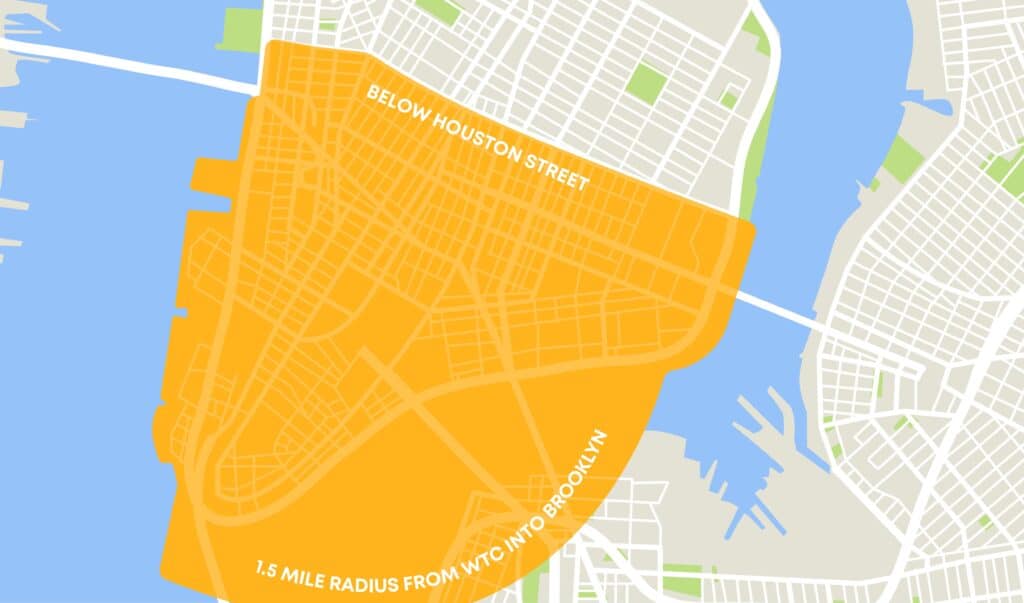
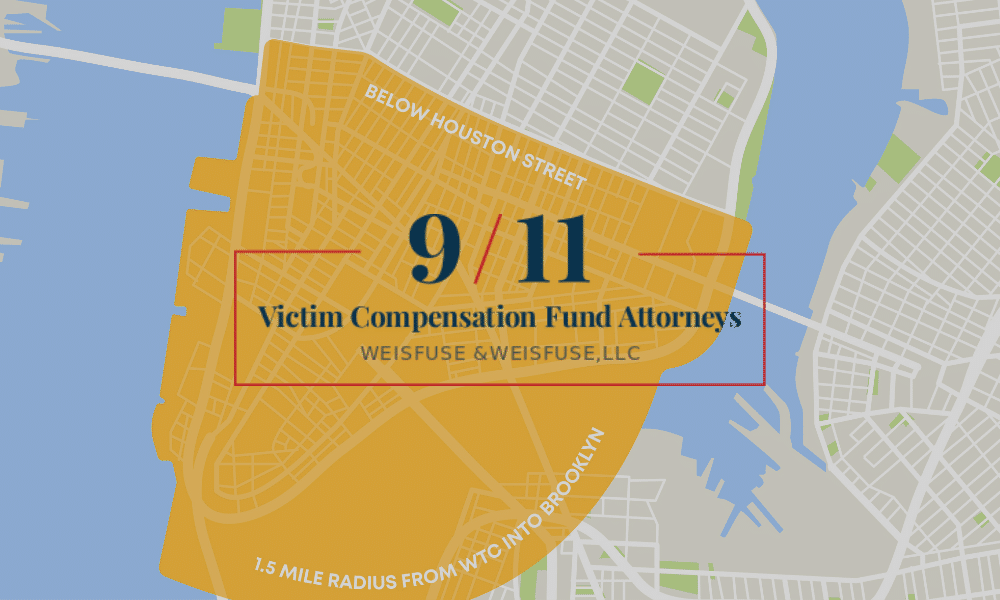
This exposure zone differs slightly from that of the WTCHP, which extends southward from Houston Street. This covers all of Lower Manhattan below that line. That reaches farther north than the VCF’s line at Canal Street. The WTCHP zone also includes parts of Brooklyn, including blocks within 1.5 miles of the former World Trade Center site. Brooklyn falls outside the VCF’s exposure zone.
Does More Time in the Exposure Zone Increase Compensation?
Not directly. A person only needs to clear the minimum time threshold for their category. After that, more time in the exposure zone does not automatically raise the compensation amount. The VCF compensates victims according to the condition they’re diagnosed with. It also looks at how severe that condition is and how much it affects daily life. This decides the amount of compensation, rather than a simple per-day or per-hour formula.
Some people assume that a brief presence in the 9/11 exposure zone rules them out entirely. That is often not true. Many approved claims involve short exposures by office workers, students, and visitors who were in the area at the time. Many never returned again but may still be eligible for compensation.
No Cost To You Unless We Win
Let Us Figure Out Which Time Threshold Applies To You
Four hours, 24 hours, 80 hours, four days, 30 days – the exact rule depends on whether you were a survivor or responder, and exactly when you were in the exposure zone. Our team sorts out which threshold applies to your situation and helps you gather the proof to back it up. Consultations are always free, and you owe Weisfuse & Weisfuse, LLC nothing unless your claim is successful.
Request A Free ConsultationHow Can Someone Prove Time Spent in the Exposure Zone?
Recalling that you spent a lot of time in the exposure zone is different from proving it.
The simplest way to prove presence in the exposure zone to the WTCHP or VCF is by showing:
- Pay stubs from local employers,
- School enrollment records,
- Utility bills tied to an address in the zone,
- Lease agreements and mail delivered to a zone address,
- Sworn statements from employers or coworkers, or
- Government proof of presence affidavits.
Gathering thorough records early tends to make both processes smoother down the line.
Contact Weisfuse & Weisfuse for a Free Consultation
If you’re unsure which time threshold applies or how to prove you meet the threshold, we can help. Our team has spent years helping survivors, responders, and families work through exactly this type of issue. Jason Weisfuse has personally handled thousands of 9/11 VCF claims.
To discuss your situation and learn more about how we may help you, please contact us to schedule a free consultation.
9/11 Exposure Zone Time Requirement Questions
Answers to common questions about the specific time and exposure zone requirements for VCF and WTC Health Program claims.
General responders need to meet one of three thresholds: at least 4 hours between September 11 and 14, 2001, at least 24 hours between September 11 and 30, 2001, or at least 80 hours through July 31, 2002. Active or retired FDNY members need at least 4 hours of exposure between September 11, 2001 and July 31, 2002.
No. The VCF's Lower Manhattan zone runs south of Canal Street, while the WTC Health Program's zone extends further north to Houston Street and also includes Brooklyn blocks within 1.5 miles of the former World Trade Center site. Brooklyn is not part of the VCF's exposure zone.
Common proof includes pay stubs from a local employer, school enrollment records, utility bills or lease agreements tied to a zone address, mail delivered to that address, sworn statements from employers or coworkers, and government proof-of-presence affidavits. An attorney can help identify which records best support your specific timeline.
About Jason Weisfuse –
9/11 Victim Compensation Fund Attorney
About Jason Weisfuse –
9/11 Victim Compensation Fund Attorney
Jason E. Weisfuse is a seasoned 9/11 Victim Compensation Fund attorney and owner of Weisfuse & Weisfuse, LLC, a New York City-based law firm dedicated to representing individuals affected by the September 11th attacks. Since the establishment of the September 11th Victim Compensation Fund (VCF), Jason has been instrumental in assisting first responders, survivors, and families in securing the compensation and medical benefits they deserve. He will personally be submitting your claim and will be your primary contact throughout the process.
As a graduate of New York Law School (2009), Jason brings extensive experience regarding the 9/11 Victim Compensation Fund to his practice. His deep understanding of the VCF and the World Trade Center Health Program (WTCHP) has enabled him to navigate complex claims processes effectively, resulting in substantial awards for his clients.
Jason is a member of the New York State Trial Lawyers Association and the American Association for Justice and has been published in the New York Law Journal.
Get In Contact Today
If you are a current client, please email Jason at jw@weisfuse.com with your questions. All information provided is safe & confidential.
No phone/mobile number information will be shared with third parties/affiliates for marketing/promotional purposes. All the above categories exclude text messaging originator opt-in data and consent; this information will not be shared with any third parties.