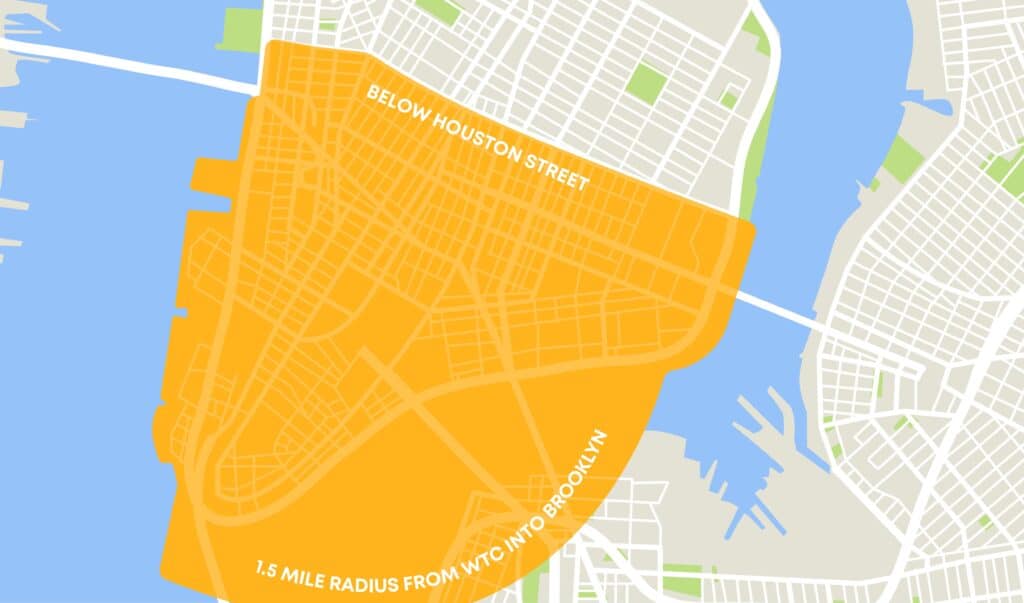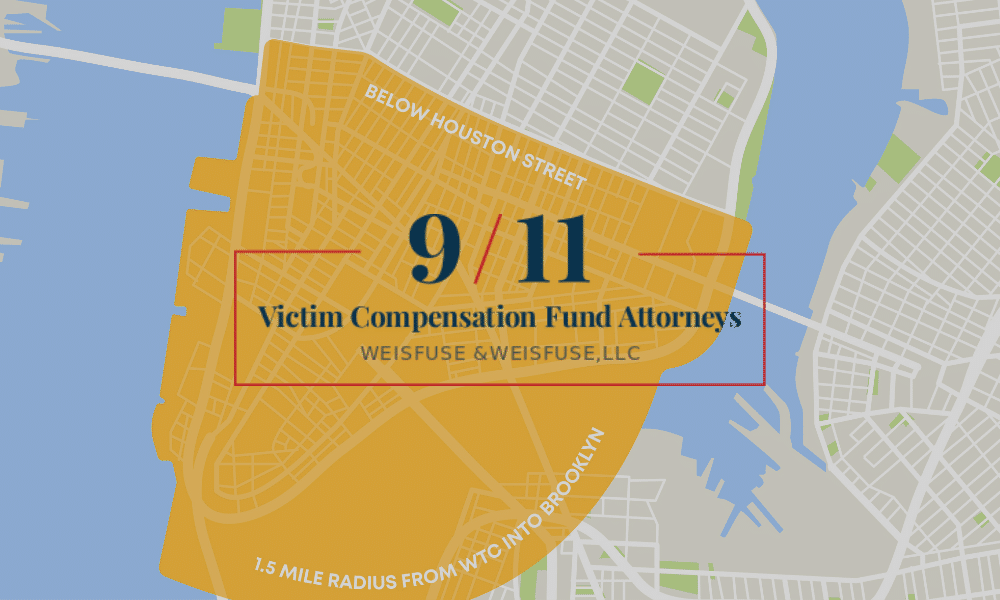

Responders or survivors who have suffered a 9/11-related injury or health condition in the decades since the attacks can claim free healthcare from the World Trade Center Health Program (WTCHP) and financial compensation from the 9/11 Victim Compensation Fund (VCF).
The families of responders and survivors who have passed away from their conditions may also be eligible for compensation.
Both economic and non-economic losses are compensable under the VCF program—but what’s the difference? What are the awards intended to cover, exactly?
Let’s take a closer look at economic vs. non-economic loss and how claims are impacted by these determinations.
What is considered an economic loss by the 9/11 VCF?
Survivors and responders are entitled to non-economic loss awards if their condition has been certified by the WTC Health Program.
Economic losses under the VCF are relatively easy to quantify, referring to the actual financial losses incurred from a 9/11-related health condition. They can usually be identified through standard documentation, such as invoices, receipts, payment records, tax returns, employment records, insurance statements, etc.
Economic losses include:
- Medical expenses (past, present, and future) not reimbursed by insurance.
- Lost earnings from missing work entirely or partly (past, present, and future).
- Lost benefits due to absence from work.
- Funeral and burial expenses (applicable in wrongful death claims).
- Replacement service costs for the families (if the deceased provided household services such as caregiving, maintenance, etc.)
These losses can impact the finances of entire families and are readily compensable under the VCF if the correct documentation is provided. This should include evidence of expenses/lost earnings and proof of presence in the exposure zone of the toxic 9/11 dust cloud between the eligible dates.
In some cases, complexities arise. With an inability to return to work, for instance, we must make calculations that include lost future earnings, including raises and benefits, while also making cost-of-living adjustments.
Employer-provided benefits include pension programs, retirement contributions, and employer-paid health insurance. Unionized employees may receive other benefits that must be factored in, too.
While economic losses may sound relatively simple on the face of it, many claimants who file for compensation without experienced assistance miss important considerations that can significantly boost claims.
What is considered a non-economic loss by the 9/11 VCF?
VCF claimants are also entitled to non-economic loss awards for WTC Health Program-certified conditions.
Just like in other personal injury claims, the non-economic losses claimable under the VCF refer to the “pain and suffering” element of 9/11’s impact on survivors and responders.
These losses are less tangible and measurable than economic losses, and must often be supported by expert assessment and opinion. Medical professionals may have to submit reports on the emotional and physical toll of the health condition, injury, or death, for instance.
Non-economic losses include:
- The pain and suffering experienced due to a physical illness or injury.
- Loss of enjoyment of life, including the inability to participate fully in relationships, social events, everyday activities, hobbies, etc.
- The emotional toll of death on loved ones, such as a spouse or dependent, due to a 9/11-related cancer or other illness (in a wrongful death claim from a family).
Note that, while mental health conditions like PTSD, anxiety, and depression are eligible to receive free monitoring and treatment through the WTC Health Program and economic loss awards under the VCF, non-economic losses are not awarded by the VCF for mental health conditions.
Non-economic losses can be particularly challenging for those inexperienced in personal injury claims to calculate. A 9/11 Victim Compensation Fund attorney will ensure that no part of your claim is overlooked.
How the 9/11 VCF calculates an economic loss claim
An economic loss award can range from a few thousand dollars to several million, depending on the claimant’s condition, age, earnings, and work history. Claims are assessed by the Special Master at the VCF.
To calculate the economic losses for a 9/11-related illness or condition, the VCF will use the following formula:
PAST ECONOMIC LOSS + FUTURE ECONOMIC LOSS – ANY OFFSETS.
Where:
Past economic loss refers to wages and benefits lost between the onset of the date of disability due to the 9/11-related illness and the time that the claim is decided.
Future economic loss refers to projected future income and benefits lost due to an inability to work because of a 9/11-related condition. This is typically based on a disability finding from the Social Security Administration (SSD), a pension board, the Workers’ Compensation Board, or the findings of a disability insurer.
Offsets refer to benefits already received, such as life insurance, pension payments, Worker’s Compensation, settlements from 9/11-related lawsuits, or awards from the Social Security Administration (SSA).
Awards for the families of deceased individuals consider the lost potential earnings that would have been due to the deceased, adjusted for benefits and inflation.
How the 9/11 VCF determines a non-economic loss claim
Non-economic claims with the VCF are capped at limits depending on whether the claimant is living or deceased, as well as the specific health condition claimed for (cancer or non-cancer conditions):
- Non-cancer conditions: Awards are usually between $10,000 and $90,000, but may be more, depending on the severity and impact of the condition. Mostly, these awards cover non-cancerous aerodigestive disorders.
- Cancerous conditions: Most 9/11-related cancer conditions are awarded $250,000 in non-economic losses. Those with multiple cancers or other non-cancerous conditions may receive more at the discretion of the Special Master.
- Wrongful death claims: $250,000 in non-economic losses is awarded for the deceased individual, plus $100,000 for the spouse and $100,000 for each dependent.
How to optimize 9/11 Victim Compensation Fund claims
Understanding the differences between economic and non-economic losses is pivotal to maximizing VCF claims. Many survivors, responders, and/or their families are entitled to more than they estimate and claim.
If claimants submit adequate supporting documentation and prepare the correct statements to claim the economic and economic losses that they are entitled to, the award can help to at least compensate part of the damage caused in the aftermath of the 9/11 attacks.
Fully covering and proving one’s losses is generally much simpler with the help of a 9/11 VCF attorney.
To discuss your situation and learn more about how we may be able to help you, please call Weisfuse & Weisfuse, LLC at 212-983-3000 or contact us online to schedule a free consultation.
About Jason Weisfuse –
9/11 Victim Compensation Fund Attorney
About Jason Weisfuse –
9/11 Victim Compensation Fund Attorney
Jason E. Weisfuse is a seasoned 9/11 Victim Compensation Fund attorney and owner of Weisfuse & Weisfuse, LLC, a New York City-based law firm dedicated to representing individuals affected by the September 11th attacks. Since the establishment of the September 11th Victim Compensation Fund (VCF), Jason has been instrumental in assisting first responders, survivors, and families in securing the compensation and medical benefits they deserve. He will personally be submitting your claim and will be your primary contact throughout the process.
As a graduate of New York Law School (2009), Jason brings extensive experience regarding the 9/11 Victim Compensation Fund to his practice. His deep understanding of the VCF and the World Trade Center Health Program (WTCHP) has enabled him to navigate complex claims processes effectively, resulting in substantial awards for his clients.
Jason is a member of the New York State Trial Lawyers Association and the American Association for Justice and has been published in the New York Law Journal.
Get In Contact Today
If you are a current client, please email Jason at jw@weisfuse.com with your questions. All information provided is safe & confidential.
No phone/mobile number information will be shared with third parties/affiliates for marketing/promotional purposes. All the above categories exclude text messaging originator opt-in data and consent; this information will not be shared with any third parties.