
Many New Yorkers who lived and worked at or near the World Trade Center in the days, weeks, and months after the September 11 attacks have faced serious long-term health consequences. A high incidence of cancer compared to the general population is one such consequence.
Lung cancer, as well as over 70 other cancers, has a known connection with exposure to the 9/11 toxic dust cloud that hung over a large area of Lower Manhattan in the aftermath of the attacks.
Here, we explore the connection and advise what can be done if, all these years later, a first responder or survivor is diagnosed with lung cancer.
The connection between lung cancer and the September 11th first responders
In the years immediately following 2001, the primary health issues for 9/11 first responders were non-cancerous respiratory conditions, such as asthma, chronic sinusitis, GERD (acid reflux), and COPD.
Because of cancer’s typically long latency period, it took over a decade for the World Trade Center Health Program (WTCHP) to officially add cancers to its list of covered conditions, finally adding the following cancers in 2012:
- Thyroid cancer
- Skin cancers (including melanoma)
- Blood and lymphatic cancers (like Leukemia and Lymphoma)
- Prostate cancer
Lung cancer was a concern given the widespread inhalation of airborne, carcinogenic toxins, but it wasn’t added to the official list until later in 2012 and 2013.
More data continued to be collected. A study on Lung Cancer Incidence After September 11, 2001, Among World Trade Center Responders was recently published in the Journal of the American Medical Association (JAMA).
This study collected data (between 2012 and 2023) from Long Island residents enrolled in a medical monitoring program available to WTC responders, who survived and were followed up for incident lung cancer after a 10-year latency period.
World Trade Center exposure severity
Details about responders’ exposure to the dust cloud during work at the WTC were collected using an extensive questionnaire that asked about activities, exposures, and experiences during work at the WTC site.
Information was gathered on exposure types, locations, specific activities, durations, and other details.
Prior studies focused predominantly on using the responders’ dust cloud exposure and the arrival date in the toxic zone to determine exposure severity. This essentially ignored the impact of settled dust, which can result in exposure to invisible, fine particulates.
This latest study developed a novel approach to more accurately assess exposure severity, using responders’ reported activities coupled with duration/timing of exposure to rank exposure severity into groups ranging from minimal exposure to severe exposure.
Results
From the 12,334 WTC responders (average age 49.3 years at study inclusion), 118 developed incident lung cancer more than a decade after exposure.
The main finding from the study was this:
“Compared with minimally exposed responders who reported low dust exposure, responders working on the WTC sites who reported more severe exposures had a nearly 3-fold higher incidence of lung cancer even after adjusting for demographic factors and smoking.
This study suggests that, when compared with the lowest reported exposure levels, a higher level of reported exposure to more particulate dust or debris was significantly associated with an increased incidence of lung cancer.”
Pulmonary nodules are common in 9/11 responders
Before the most recent study referenced above, other studies identified the higher presence of pulmonary nodules in 9/11 first responders compared with the general population.
In one study based on data collected from 1,617 World Trade Center responders between 2003 and 2012, more than half with available CT scans had evidence of pulmonary nodules.
Pulmonary nodules are small, round growths or “spots” in the lungs. They are often the result of past infections or scarring but require monitoring to ensure they are not early-stage cancer. Malignant nodules will grow over time while benign ones remain stable.
The Lung-RADS system determines the nodule category, with Lung-RADS 1 or 2 being benign, 3 being probably benign, 4A suspicious, and 4B very suspicious.
Of the 1,617 study participants:
- 60% had at least one pulmonary nodule.
- 52% of these had at least one noncalcified solid nodule.
- 55% of all participants had a nodule severity of Lung-RADS 2.
- 5% had a nodule severity of Lung-RADS 3 or 4.
- Participants with nodule severity of Lung-RADS 3 or 4 also had a higher likelihood of having multiple nodules compared with participants with Lung-RADS 1 or 2.
The study concluded the following:
“Our findings, if replicated, could be supportive of the recommendation to ‘relax’ lung cancer screening eligibility criteria in consideration of occupational and environmental exposures, which may be highly relevant in the World Trade Center and other occupationally exposed populations.”
How can a 9/11 Attorney help you?
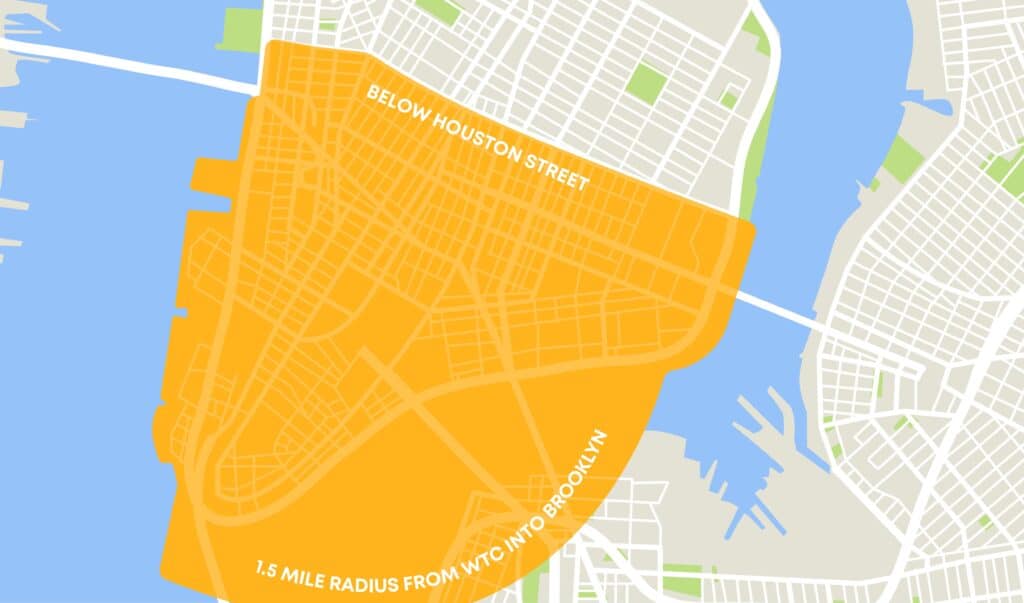
9/11 responders and survivors who were exposed to the toxic dust cloud between September 11th, 2001, and July 31st, 2002, should register with the WTCHP for free medical care and monitoring for 9/11-related health issues.
Regularly monitoring the lungs for pulmonary nodules, for instance, can help diagnose early-stage lung cancer and prompt timely treatment.
Any responder or survivor diagnosed with lung cancer or the families of loved ones who have passed away from cancer can go a step further and claim significant compensation from the September 11th Victim Compensation Fund (VCF).
Claiming full and fair compensation can be challenging without the help of an experienced 9/11 attorney. Omissions, mistakes with documentation, and other errors can result in delays or even claim refusal.
A 9/11 lawyer will help with:
- Navigating the complex rules, forms, and other documentary requirements from the Department of Justice (DOJ).
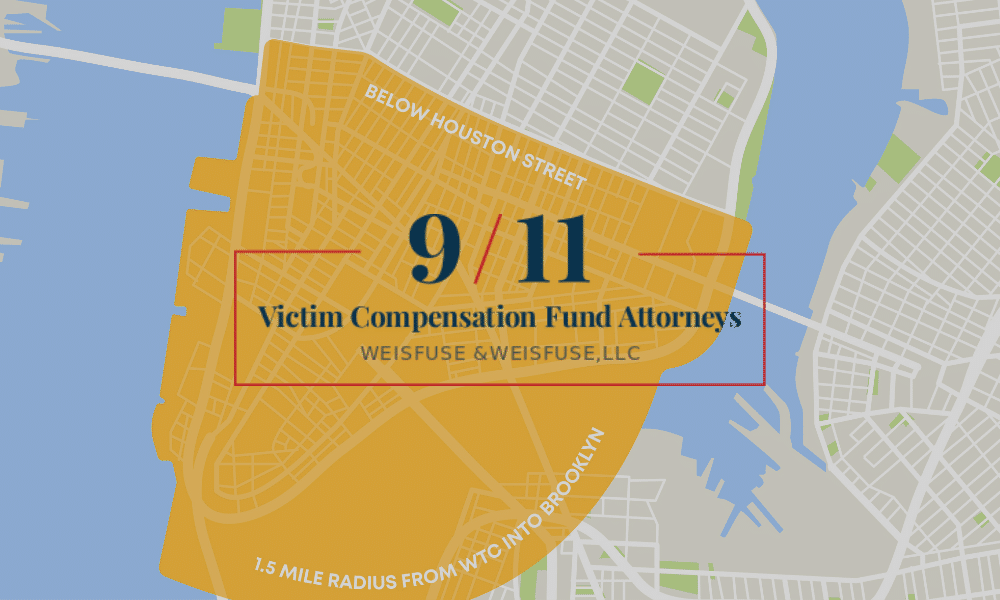
- Preparing the evidentiary paperwork required to prove presence in the Exposure Zone during the eligible dates for the WTCHP and VCF.
- Preparing the medical documentation to prove a qualifying 9/11-related condition (and its effect on the victim’s life) for the maximum VCF compensation (economic and non-economic losses).
- Responding to any request for information relating to claims.
- Ensuring that deadlines/timelines are met and the case proceeds without unnecessary delays.
Ultimately, legal assistance with registration and claims reduces the burden and stress for responders and survivors with lung cancer, allowing them to focus on recovery.
To discuss your situation and learn more about how we may be able to help you, please call Weisfuse & Weisfuse, LLC at 212-983-3000 or contact us online to schedule a free consultation.
About Jason Weisfuse –
9/11 Victim Compensation Fund Attorney
About Jason Weisfuse –
9/11 Victim Compensation Fund Attorney
Jason E. Weisfuse is a seasoned 9/11 Victim Compensation Fund attorney and owner of Weisfuse & Weisfuse, LLC, a New York City-based law firm dedicated to representing individuals affected by the September 11th attacks. Since the establishment of the September 11th Victim Compensation Fund (VCF), Jason has been instrumental in assisting first responders, survivors, and families in securing the compensation and medical benefits they deserve. He will personally be submitting your claim and will be your primary contact throughout the process.
As a graduate of New York Law School (2009), Jason brings extensive experience regarding the 9/11 Victim Compensation Fund to his practice. His deep understanding of the VCF and the World Trade Center Health Program (WTCHP) has enabled him to navigate complex claims processes effectively, resulting in substantial awards for his clients.
Jason is a member of the New York State Trial Lawyers Association and the American Association for Justice and has been published in the New York Law Journal.
Get In Contact Today
If you are a current client, please email Jason at jw@weisfuse.com with your questions. All information provided is safe & confidential.
No phone/mobile number information will be shared with third parties/affiliates for marketing/promotional purposes. All the above categories exclude text messaging originator opt-in data and consent; this information will not be shared with any third parties.